About Us
 Careers
 Leadership
 Board
Board Newsroom
One SaaS platform serving managed service providers (MSPs) felt this pressure directly. Its own product roadmap was falling behind, and its MSP customers were asking for capabilities the platform did not have yet. Rather than pulling engineers off the core product for another year of internal builds, the company partnered with Vendasta to embed a white-label AI stack its MSP customers could buy into. Eighteen months later, that decision was generating more than $4.5 million a year in upsell revenue from existing customers, at 75% gross margins.
We will walk through exactly how they did it later in this article. A SaaS upsell strategy is a structured plan for growing revenue from customers you already have by moving them to higher-value plans, more seats, or expanded usage, instead of relying only on new customer acquisition.
Businesses that sell to an existing customer succeed 60 to 70% of the time, compared to just 5 to 20% for a brand-new prospect, according to Paul Farris’s research in Marketing Metrics. That is the math behind why upselling deserves its own strategy, not just an occasional renewal email. In this guide, we will cover what a SaaS upsell strategy actually involves, the tactics that separate upsells that convert from ones that get ignored, a full breakdown of the case study above, and the tools that make it possible to manage upsells across many accounts without adding headcount.
Attract, convert, and retain more customers with less manual work
TL;DR
What Is a SaaS Upsell Strategy?
A SaaS upsell strategy is a repeatable plan for encouraging existing customers to spend more with you, whether that means upgrading to a higher-tier plan, adding seats, or expanding their usage of a product they already pay for. The word “strategy” is doing real work in that definition. Asking a customer if they want to upgrade during a renewal call is not a strategy. A strategy means you have defined triggers, a consistent process for acting on them, and a way to measure whether it is working.
A real upsell strategy generally requires a few things working together:
- A clear view of how customers are actually using your product
- Defined triggers, such as usage thresholds, new feature adoption, or team growth
- A consistent way to act on those triggers, whether in-app, by email, or through a sales conversation
- A way to measure results, typically expansion revenue and net revenue retention
Businesses researching this topic will often see it phrased slightly differently: an upsell strategy for SaaS, SaaS upsell strategies, or expansion revenue strategy. They all point at the same idea: growing revenue from the customers you already have, on purpose, instead of by accident.
Upsell vs. Cross-Sell vs. Renewal: What’s the Difference?
These three terms get used interchangeably, and that confusion causes real strategy problems, since each one calls for a different approach.
- Upselling means moving a customer to a higher tier, more seats, or expanded usage of the product they already have.
- Cross-selling means selling a customer an additional, different product or service.
- Renewal marketing is the deliberate effort to keep and grow an account at the moment its subscription comes up for renewal.
Renewal is not a separate motion from upselling. It is simply the highest-leverage moment to make the ask. A business that treats renewal purely as a defensive conversation, focused only on retention, is leaving expansion revenue on the table. The strongest renewal and upsell marketing strategies use the same usage data and triggers, just timed to land right before the contract comes up.
Why a SaaS Upsell Strategy Matters More Than You Think
Growing revenue from existing customers costs less and closes faster than acquiring new ones. The numbers back this up clearly:
- Existing customers convert at 60 to 70%, compared to 5 to 20% for new prospects, per Marketing Metrics author Paul Farris.
- Median net revenue retention across private B2B SaaS companies fell from 105% in 2021 to 101% in 2024, according to Benchmarkit and Maxio’s annual SaaS performance benchmarks, meaning most companies are barely growing existing accounts faster than they lose them.
- In Kyle Poyar’s 2026 survey of 230 B2B software and AI companies, not enough expansion revenue was the single most common monetization complaint.
Put those three together and the picture is clear. Existing customers are the easiest revenue to close, most companies are not growing them fast enough, and it is the top monetization headache in the industry right now. That is not a coincidence. It means most SaaS and software businesses know upselling matters but have not built a real process around it.
This math hits agencies, franchisors, and ISVs even harder. If you are managing dozens or hundreds of SMB client accounts instead of one product with one set of usage metrics, you have the same expansion opportunity spread across far more accounts, which makes it nearly impossible to track manually. That gap is exactly what pushed one MSP-focused SaaS platform toward a different approach, which we will get into shortly.
7 SaaS Upsell Strategies That Actually Work
The tactics below are not theoretical. Each one reflects a real behavioral pattern that separates upsell offers customers respond to from ones they ignore or resent.
1. Use Behavioral Triggers, Not the Calendar
The best upgrade prompts fire because something changed in how a customer is using your product, not because a quarter ended. A customer who just hit a usage ceiling or explored an advanced feature for the first time is in a completely different mindset than one getting a generic quarterly check-in.
Common triggers worth tracking:
- Hitting a usage or storage limit
- Repeated use of a feature outside the customer’s current plan
- Adding new team members or seats
- Engaging with pricing or billing pages
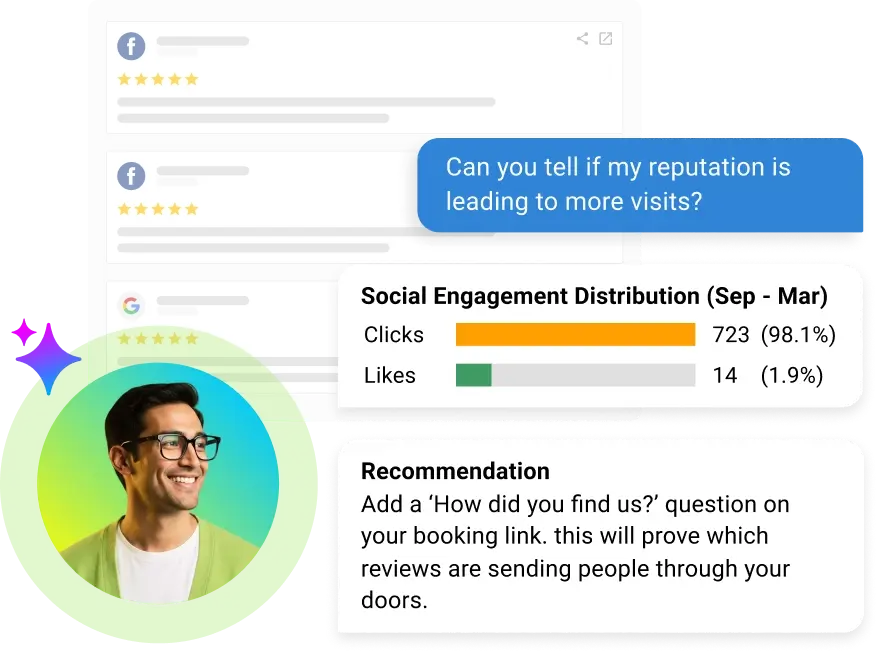
Tracking these triggers manually across a handful of accounts is manageable. Tracking them across hundreds of SMB clients is a different problem entirely, and it is exactly where an AI-driven approach starts to pay off, since a tool like Vendasta’s AI Data Analyst can monitor usage signals across an entire portfolio and flag accounts the moment they cross a threshold.
2. Demonstrate Value Before You Make the Ask
An upsell should follow proof, not come before it. Customers need evidence they are already getting value, whether that is a usage report, a results recap, or a visible outcome, before an upgrade offer feels reasonable instead of pushy.
Practical ways to do this include sending usage summaries, highlighting results already achieved, or showing a customer exactly how close they are to a limit they are about to benefit from raising.
3. Time the Offer to Attention, Not to the Contract Date
The best moment to upsell is when a customer is actively engaged, not whenever the renewal date happens to land. Waiting for a quarterly business review or a contract anniversary means the momentum has often already faded by the time you show up with an offer.
If an account is actively adopting a new feature or growing usage this week, that is the moment to start the conversation, not three months from now when the calendar says it is time.
4. Match the Upsell to Your Pricing Model
How you frame the upgrade should match how you actually charge. A seat-based business should frame upsells around adding users. A usage-based business should frame them around expanded capacity. A feature-based business should frame them around unlocking new capability.
Mixing these up creates confusing messaging. A usage-based customer does not care about adding seats if their real constraint is monthly capacity, and vice versa. Getting this right is central to how the best AI tools that accelerate ARPU actually work, since the pricing model determines which lever drives expansion fastest.
5. Personalize the Offer to What the Account Is Actually Doing
A generic “upgrade now” email underperforms an offer built around a specific account’s real usage. An account using three or more advanced features in the last month is a fundamentally different conversation than one still using basic functionality.
This is where personalization at scale becomes difficult without help. If you are an agency or ISV managing many SMB client accounts, building individual usage profiles by hand is not realistic, and that gap is exactly what stalls recurring revenue for agencies. This is one of the areas where AI Employees like Vendasta’s AI Inside Salesperson can qualify and prioritize accounts automatically, so your team spends time on the conversations most likely to close.

6. Treat Renewal as an Expansion Moment, Not Just a Retention Checkpoint
Renewal is the single highest-leverage moment for an upsell, but only if you walk in with usage data instead of just a contract to sign. Before a renewal conversation, it is worth checking a few signals: is usage trending up, have new users been added, has the account started using advanced features for the first time, and has engagement with pricing pages increased.
A useful habit is setting a reminder 60 days before any renewal where an account clears two or more of these signals, so the upsell conversation is planned instead of a last-minute scramble.
7. Automate the Detection, Not the Relationship
The goal of automation is to catch upsell-ready accounts faster, not to replace the human conversation that actually closes the deal. This is where Vendasta’s approach differs from a typical analytics tool. AI Employees like AI Data Analyst and AI Inside Salesperson monitor account activity across an entire book of SMB clients and surface the accounts ready for an upsell or renewal conversation, so your team focuses its time where it counts instead of digging through spreadsheets.
That is close to what happened with the MSP-focused SaaS platform we mentioned earlier. Once new capabilities like reputation management were live on the platform, turning them on for an existing MSP customer took one click rather than a fresh sales cycle. When 300 MSP customers asked for reputation management, the partner’s team activated it instantly through Vendasta’s ordering system, which handled provisioning and billing without any new integration work.
How to Build a SaaS Upsell Strategy in 5 Steps
Here is a practical, five-step process you can start applying this week.
Step 1: Map Your Customer Usage Data
Start with what you already have access to, such as logins, feature usage, seat counts, or support ticket volume. If you are an agency or ISV reselling tools to SMB clients and you currently have no visibility into how those clients use the product, that visibility gap is the first problem to solve before you can build any real trigger system.
Step 2: Define Your Upgrade Triggers
Pick three to five specific behaviors that should kick off an upsell conversation, drawing from the triggers covered earlier in this guide. Resist the urge to track everything at once. Start narrow, prove the model works, then expand.
Step 3: Build Segments Around Expansion Readiness
Group accounts by trigger status instead of treating every customer identically. Accounts showing multiple signals at once, such as rising usage plus new users plus first-time feature adoption, should be your highest priority segment.
Step 4: Choose the Right Channel and Message for Each Segment
Match the channel to the account. Self-serve behaviors are well suited to in-app messaging, while higher-touch accounts deserve direct outreach or a call. Whatever channel you use, keep the message specific to what that account is actually doing, not a generic pitch.
Step 5: Track Expansion Revenue and Net Revenue Retention
These two metrics are your scoreboard, and they sit at the center of long-term SaaS customer retention. Review expansion revenue and net revenue retention monthly, and revisit your trigger definitions every quarter as you learn what is actually predicting upgrades.
SaaS Upsell Strategy Tools Compared
Most tools in this space fall into one of two buckets: usage analytics platforms built for a single product, or CRM and customer success tools built for sales-led teams. Few are built specifically for a partner managing upsells across a large portfolio of SMB accounts, which is where Vendasta’s approach stands apart.
| Platform | Built For | Key Upsell Capability | Best For |
|---|---|---|---|
| Vendasta | Agencies, franchisors, and software vendors serving SMBs | AI Employees monitor client usage and surface upsell and renewal-ready accounts automatically, with one-click activation for new product lines | Businesses managing upsells across many SMB client accounts without adding headcount |
| Product usage analytics platforms | Product-led SaaS companies | In-app usage tracking and triggered upgrade messaging | Companies selling one product directly to end users |
| CRM and customer success platforms | Sales-led B2B teams | Account health scoring and renewal alerts | Teams with a dedicated customer success function |
The distinction matters most for anyone managing a portfolio rather than a single product. A usage analytics tool can tell you a customer hit a limit. A CRM can remind you a contract is renewing. Vendasta’s AI Employees are built to connect that account-level detection to action across many accounts at once, without requiring a bigger team to manage it.
Real-World Example: How One SaaS Platform Built a $4.5M Upsell Engine
This story comes from a leading software platform built for managed service providers (MSPs), handling billing, project management, ticketing, and day-to-day operations for thousands of MSP customers. Vendasta keeps the partner’s name confidential at their request, since many enterprise ISV partners prefer Vendasta to operate as the engine behind their platform rather than a visible brand name.
The challenge: MSPs using the platform kept asking for one capability it did not have: a CRM to manage their own customers. The company had already committed publicly to shipping it by a set deadline. After roughly six months of in-house engineering work, the team realized a multi-tenant CRM built from scratch would take far longer and cost far more than expected, with the deadline closing in fast.
That put the company at a classic build-versus-buy decision. Whatever they brought in had to be white-label, meet enterprise standards for security and compliance, and be extensible enough to support a full marketing and AI suite down the road, not just a one-off CRM. A well-known SMB marketing platform was the first option on the table, but the partnership stalled the moment procurement got involved. Contract terms were not enterprise-grade, and the vendor could not answer basic questions about security audits or data handling.
Vendasta’s onboarding process looked different from the start, with a standardized enterprise service agreement, documented data and privacy policies, SOC 2 compliance, and a clear 90-day plan for single sign-on and tech stack integration.
Execution: The partner and Vendasta agreed on an aggressive rollout: a 90-day integration phase, an initial launch to 500 MSP accounts, and a plan to add 250 accounts each quarter for two years, targeting 2,000 accounts by year two. The platform shipped in under nine months, hitting the original customer-committed deadline, with Business App and CRM as the central hub, alongside Social AI, Conversations AI, Campaigns Pro, and WordPress Hosting.
The AI layer moved fastest of all. One MSP that deployed the AI Receptionist on its website converted 70% of its leads in the first month, with the AI employee engaging prospects and qualifying leads directly through the site without interrupting the MSP’s daily work.
“One of our MSP clients that implemented the AI lead capture on their website has converted 70% of their leads since they started using it about a month ago. They’re able to have AI communicate with a potential prospect directly through their website without having to interrupt their daily work.”
— MSP Enablement Platforms Manager
As MSP demand grew, the partner kept adding product lines, including Reputation AI, listings management, and premium WordPress hosting, without writing a single new line of integration code. When 300 MSP customers requested reputation management at once, the team turned it on with a single switch, and Vendasta’s ordering system handled provisioning and billing automatically.
The results: Eighteen months in, the numbers told a clear story.
| Before Vendasta | With Vendasta |
|---|---|
| Six months of internal CRM development with no shippable product | Shipped a white-label CRM and marketing platform in under nine months |
| A planned two-year roadmap to 2,000 MSP accounts | Already at 2,000 accounts, ahead of schedule |
| Forecasted roughly $70K monthly run rate through Vendasta | Running at roughly $130K a month, nearly double the original forecast |
| No straightforward way to ship AI to MSP end customers | AI Employees like AI Receptionist and AI Reputation Specialist live and in use |
| No upsell revenue from new product lines beyond the core platform | More than $4.5 million in annual upsell revenue from new product lines sold to existing MSPs |
The partner’s enablement team put it simply:
“Our partners are really excited to have everything in one place. Before Vendasta, they used all different types of platforms, but they would have to hop from one to another to accomplish their marketing.”
— MSP Enablement Platforms Manager
The underlying lesson applies well beyond one MSP platform. Once the foundation was in place, new product lines became upsell opportunities that could be turned on instantly instead of requiring a fresh sales cycle or another engineering sprint. That is the difference between hoping customers upgrade and building a system that surfaces the moment they are ready to.
Common SaaS Upsell Mistakes to Avoid
- Upselling before demonstrating value: asking for more money before a customer has proof they are getting value from what they already pay for.
- Treating every customer the same: sending identical upgrade messaging to accounts with completely different usage patterns.
- Waiting for the renewal date to start the conversation: missing the window when engagement, and receptiveness, is highest.
- Over-relying on discounts to force upgrades: short-term conversions that attract price-sensitive customers who tend to churn quickly.
- No clear way to measure success: running upsell campaigns without tracking expansion revenue or net revenue retention, so there is no way to know what is actually working.
- Manually tracking usage across too many accounts: especially common for agencies and franchisors managing dozens or hundreds of SMB clients, where manual tracking simply does not scale.
Conclusion
A strong SaaS upsell strategy comes down to three things: proof, timing, and data. Customers need to see the value they are already getting before you ask for more. The offer needs to land while they are engaged, not on a fixed calendar date. And none of it works without visibility into what your customers are actually doing.
For agencies, franchisors, and software vendors managing this across dozens or hundreds of SMB accounts, doing it by hand does not scale. The MSP-focused SaaS platform in this article did not grow its upsell revenue by hiring a bigger team. It grew by building a foundation where new product lines could be detected, activated, and sold into its existing base automatically. That is exactly what Vendasta’s AI Employees and unified platform are built to do for agencies, franchisors, and software vendors who want to add revenue without adding headcount.
Book a demo with Vendasta today!
SaaS Upsell Strategy FAQs
1. What is a SaaS upsell strategy?
A SaaS upsell strategy is a structured plan for growing revenue from existing customers by moving them to higher-tier plans, more seats, or expanded usage. It relies on defined triggers and consistent follow-through, rather than one-off upgrade requests during a renewal call.
2. How is upselling different from cross-selling in SaaS?
Upselling means selling more of the same product a customer already has, such as a higher plan tier or more seats. Cross-selling means selling a different product entirely. Both grow revenue from existing customers, but they use different messaging and timing.
3. What triggers should I use to identify upsell opportunities?
Strong triggers include usage nearing a plan limit, repeated use of a feature outside the current tier, new team members being added, and increased engagement with pricing pages. Vendasta’s AI Data Analyst can monitor these signals automatically across an entire portfolio of client accounts.
4. How do I create a renewal and upsell strategy for SaaS?
Start by tracking usage signals, such as rising engagement or new feature adoption, in the 60 to 90 days before a renewal. Use that data to walk into the renewal conversation with a specific expansion offer instead of just a contract to sign. Vendasta can surface these renewal-ready accounts automatically, so nothing slips through.
5. What is a good SaaS upsell conversion rate?
Conversion rates vary widely by product, industry, and how well-timed the offer is, so there is no single universal benchmark. Businesses with strong usage data and clear triggers typically convert upsells at meaningfully higher rates than those relying on generic, calendar-based outreach.
6. Do I need customer usage data to run an upsell strategy?
Yes. Usage data is what separates a real upsell strategy from occasional upgrade emails sent on a hunch. Without it, you cannot identify which accounts are actually ready to expand. Vendasta gives agencies and partners visibility into client account activity without needing a separate analytics tool.
7. How can agencies upsell SaaS tools to their SMB clients without adding staff?
Agencies can use AI to monitor client usage across their entire book of business and flag accounts showing expansion signals. Vendasta’s AI Employees, including AI Data Analyst and AI Inside Salesperson, handle this detection automatically, so agency teams can focus their time on the conversations most likely to close.
8. What’s the best time to offer an upsell during a customer’s lifecycle?
The best time is when a customer is actively engaged, such as right after hitting a usage milestone or adopting a new feature, rather than waiting for a fixed calendar date like a quarterly review. Timing the offer to behavior instead of the calendar consistently improves response rates.
9. Can AI help identify SaaS upsell opportunities?
Yes. AI tools can monitor usage patterns across many accounts and flag upsell-ready customers far faster than manual review. Vendasta’s AI Data Analyst and AI Inside Salesperson are built specifically to surface these opportunities for partners managing large SMB client portfolios.
10. How does Vendasta help businesses with SaaS upsell and renewal strategies?
Vendasta is an AI-powered platform that helps agencies, franchisors, and software vendors monitor SMB client usage and surface upsell and renewal opportunities through AI Employees, all from a single rebrandable platform. One SaaS partner used this approach to build more than $4.5 million in annual upsell revenue from its existing customer base.